Free Printable Office Human Bingo
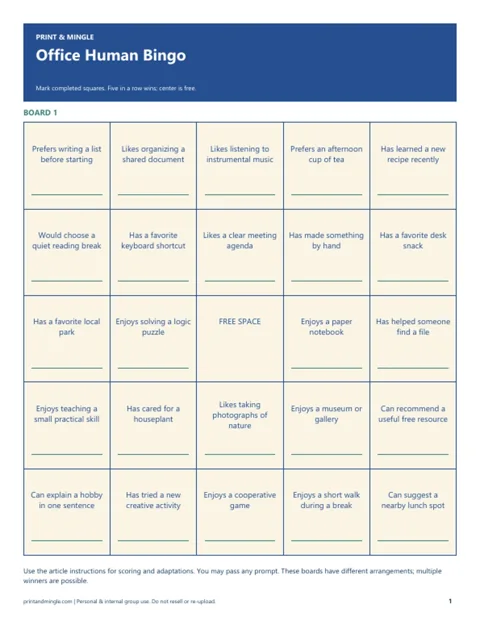
Jump to downloadSix original office human bingo boards with 24 low-pressure conversation prompts, a free center, and inclusive rules.
An office icebreaker with a clear purpose
Office human bingo gives coworkers a simple reason to introduce themselves and discover everyday interests beyond a job title. Participants speak to colleagues, find people who match the prompts on their boards, and write their names in the squares. The activity is designed for an optional social or onboarding session rather than a performance assessment. It works best with eight or more participants and a clear fifteen-to-twenty-minute window. Tell the group that the aim is a few useful conversations, not collecting personal information at speed. No one needs to demonstrate a talent, disclose a private circumstance, or explain why they prefer to sit out.
What is included in the six-board pack
The color printable contains six different arrangements of 24 original prompts on 5 by 5 boards, each with a free center. All six use the same prompt pool; their positions change so winning lines differ. For more than six participants, repeat the pack and spread matching boards around the room. The file does not contain a unique board for every possible attendee. Choose A4 or US Letter to match your printer and give everyone one board plus a pen. Blue, teal, and warm yellow provide a distinct office-friendly palette while leaving enough white space to write first names clearly.
Explain names, repeats, and the winning pattern
Players must have a brief conversation with someone before adding that person's name. A colleague decides for themselves whether a prompt fits. For eight to twelve people, allow a name to appear twice on a board but only once within a winning line. With thirteen or more, use a different name for each square. Nobody signs their own board, and the center is free from the start. A completed row, column, or diagonal of five spaces wins. Announce the rule you choose before distributing boards. These limits matter because allowing unlimited repeats lets one conversation complete a line and removes the reason to mingle.
An example exchange and a simple winner check
A player might ask someone whether they enjoy a paper notebook. If the answer is yes, they write that colleague's first name in the matching square and can ask what they find useful about it. A short exchange is enough; this is not a demand for a demonstration of someone's note-taking system. When a player completes a line, they call bingo and the host checks that its names follow the repeat rule. Invite one voluntary highlight about something they learned, without requiring the named colleague to give a public speech. Let the rest of the group finish the current conversation before announcing the next round or ending.
Run a seated or remote version
Walking around is optional. For a seated event, put participants into pairs for two minutes, then change partners or let people introduce a willing colleague who matches a square. A wheelchair user or anyone who prefers to remain seated can take part through the same partner rotations without being made the focus. For remote teams, use small breakout groups and rotate once or twice if your meeting platform supports it. Participants can keep a printed board beside them or annotate their own PDF copy. Read the instructions aloud and paste the basic rules into the meeting chat so nobody must rely on tiny screen-shared text.
Keep the game suitable for work
The supplied prompts concern preferences, light hobbies, and practical habits. They do not ask about health, salary, relationships, religion, immigration, alcohol use, or political views. Preserve that boundary when adding your own examples. A manager should not record who completes a board or treat reluctance as a teamwork problem. Names written on the sheets are for the game, not an employee-interest database. If someone says a square does not apply, move on without asking them to justify it. For a new starter, pair them with a welcoming colleague rather than assuming they already know where everyone sits or how to pronounce every name.
Print and close without over-running the session
Print one board at actual size and check that all cell text is readable and the bottom row is complete. Standard paper is enough; a clipboard helps if participants will stand. Set a visible timer and announce a two-minute warning so conversations can finish naturally. If no one has a line, recognize the most completed squares only if that fallback was explained at the start, or simply close without a winner. Ask everyone to recall one useful new connection for themselves. Collect spare sheets and let people keep or discard their own boards rather than photographing handwritten names for a public company post without consent.
Download The Printable
Free 6-page PDF. Choose your paper size.
US Letter PDF A4 PDFPersonal gatherings and internal group use. Please do not resell or re-upload the files. Usage terms
Original AI-assisted material, checked digitally. No in-person playtest or physical print test; timing is suggested.