Free Printable Dinner Party Conversation Cards
Jump to downloadSkip the small talk. Twenty-four thoughtful, light-hearted prompts for a table of friends, old or new.
What you receive and when to use it
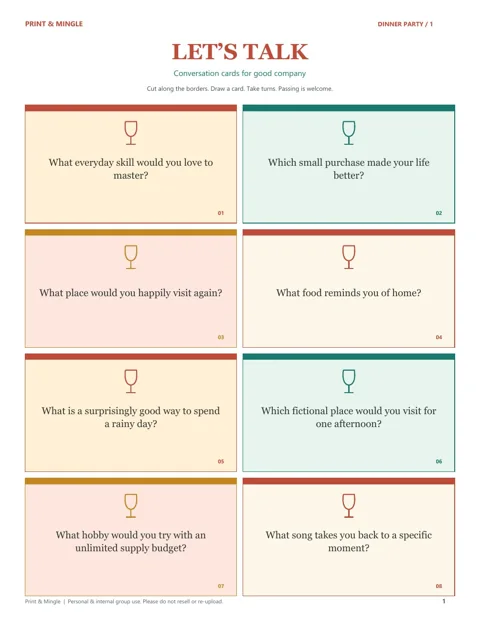
The good conversation deck contains 24 original question cards across three printable pages. The A4 and US Letter editions contain the same questions, so download the edition matching your printer paper. This is a discussion activity for approximately 3–12 people, with a suggested 20–40 minute window. Those are planning estimates rather than measured playtest results. You can also leave the deck on a dinner table for occasional questions between courses instead of announcing a formal game.
The questions cover everyday interests, food, places, memories and small pleasures. Examples include what food reminds someone of home, which everyday skill they would like to master, and what they would teach in a ten-minute lesson. The deck does not require revealing secrets, naming a favorite person at the table or agreeing with the host. Choose a few approachable cards first if some guests have only just met.
Prepare the table without interrupting dinner
Print one complete deck, cut the cards apart along their borders and place them in a small stack within easy reach. Keep the uncut pages if you prefer the host to select and read questions. No player sheets, pens or answer key are needed. Put the stack away from drinks, candle flames and serving dishes. For a long table, divide the deck between two ends so everyone can hear the people answering near them.
Before beginning, explain two boundaries: anyone may pass without giving a reason, and a short answer is enough. Guests may answer with a real experience, an imagined possibility or a general preference when that makes them more comfortable. The purpose is to make joining the conversation easier; it is not an interview or a memory test.
A simple way to take turns
Invite one volunteer to draw a card, read it aloud and answer first. Then invite one or two other people to contribute before moving the stack to the next person. Letting everyone answer every question can make a large table wait too long, so alternate between an open discussion and a brief round. Stop a round when the conversation develops naturally; you do not have to complete all 24 questions.
For example, a guest draws “What would you teach in a ten-minute lesson?” and describes folding a fitted sheet. Another guest offers a simple cooking technique. The host can ask what a beginner would need to get started, then invite the next player to draw. A useful follow-up explores the answer already given rather than pushing for a more personal story.
Adapt the deck to different groups
With three or four people, allow everyone to respond and follow interesting tangents. With eight to twelve, ask people to chat in pairs about one card, then invite a few highlights for the whole table. For a mixed-age adult group, start with hobbies, food or a free afternoon rather than assuming everyone shares references to the same music or childhood experiences.
If a question about home, advice or a memory feels uncomfortable, simply replace it. Never choose a card specifically to make one guest disclose something. Read cards aloud for anyone who finds the printed text difficult to see, and give people who use another language extra thinking time. A person who prefers listening can stay involved without taking a speaking turn.
Keep it conversational rather than competitive
There is no score, correct answer, winner or elimination. Avoid voting for the funniest or most impressive response, particularly when new guests are present. If you want a small structure, let each person choose one card they would like the table to discuss, then finish after that round. This gives quieter guests influence without requiring a long answer.
For a remote dinner, one person can hold the printed deck and read a question while others answer aloud or in chat. For a meal with several courses, use two or three questions while people settle in, put the cards aside during serving, and return to them only if guests want another round. A lively unrelated conversation is a successful reason to stop.
Print and store your color cards
Use portrait orientation and print a single-sided test page at actual size or 100 percent. Check that the card borders fit inside the printable area before running the remaining two pages. Ordinary paper works; heavier paper can make repeated handling easier if your printer supports it. Keep the printer driver on the same paper size as the downloaded file, and do not select a multi-page-per-sheet setting.
The color layout distinguishes the deck visually, while the questions remain readable without color. Cut after printing rather than trying to feed small pieces through a printer. Store the cards in an envelope and share this article link with other hosts instead of uploading the PDF elsewhere. Copies are permitted for personal gatherings and internal group activities; the files may not be resold or redistributed.
Download The Printable
Free 3-page PDF. Choose your paper size.
US Letter PDF A4 PDFPersonal gatherings and internal group use. Please do not resell or re-upload the files. Usage terms
Original AI-assisted material, checked digitally. No in-person playtest or physical print test; timing is suggested.